Industries

What a warehouse and business system has to do depends on what is being handled. A chilled warehouse working to best-before dates is not run like a spare parts store, and a third-party operator invoicing per activity performed has requirements a wholesaler does not. Below are the industries we have worked in longest, and what is distinctive about each.
Food
The food industry places demands few other industries do. The goods are perishable, and traceability back to batch has to be there on the day a recall becomes necessary. Epix handles batch and serial number tracking as part of the ordinary warehouse flow rather than as an add-on: each unit can be traced back to its origin and forward to its destination.
Quality control sits as a gate in the goods reception flow, so that goods do not reach a picking location until they have been approved, and goods under receipt or return are held on separate balances. Recipe production with batch preparation and reporting of scrap sits in the same system as orders and invoicing, which means material consumption can be followed up without reconciling separate registers.
Our customers here include food producers, ingredient and raw material wholesalers, and bakeries — Almondy, KåKå, Lyckeby Culinar, Orkla Food Ingredients and Trensum Food.
Customer case








Retail, e-commerce and wholesale
Retail is characterised by many order lines, small pick quantities and large seasonal variation. What determines the cost per order is how far the picker walks and how many times the goods are handled. Epix batches order lines into consolidated picking rounds, calculates the route from the actual layout of the warehouse, and places high-frequency items close to the picking aisle.
Towards the sales channels, balances and orders are synchronised automatically, over EDI or a REST API depending on the counterparty. Returns are handled as a flow of their own with quality control, so that returned goods do not reach a picking location until they have been approved.
Our customers here include Jula and Rusta, both of which run warehouse operations at scale with automation — Jula with a compact warehouse, Rusta with a high-bay warehouse and pick by voice.





Third party logistics
Epix-3PL is a platform designed to efficiently manage items for multiple goods owners. Warehouse management costs are calculated based on logistics events that are either automatically recorded or manually reported.
In our warehouse hotel agreements, costs for various services related to order and warehouse management are defined, including storage rental, picking, receiving, returns handling, order placement, production, kit management, and shipping. For our warehouse hotel customers, invoices and invoice documentation for completed warehouse management services are generated at specified intervals. Additional activities and consumption can be recorded via terminal or handheld scanner as a basis for billing goods owners. Shipping fees are calculated based on various factors, such as recipient country, postal code range, transport method, distance, as well as weight and volume intervals.






Industry and Workshop
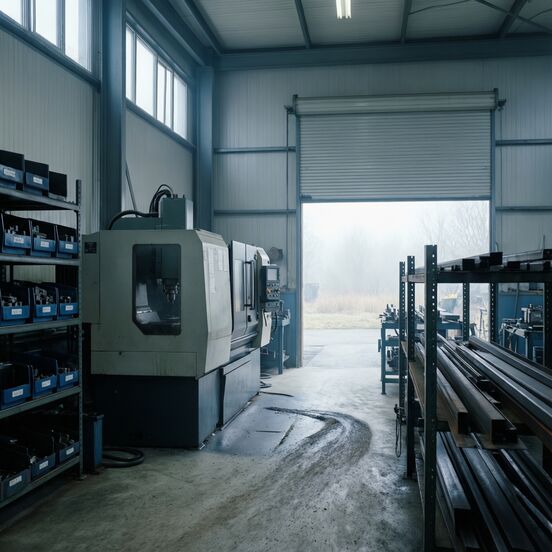
Industry and workshop is the field we have worked in longest and in the most countries. The requirements differ from those of retail: spare part ranges are deep and turn over unevenly, components must be traceable to their production batch, and manufacturing units and central warehouses have to exchange data without anyone copying figures between systems by hand.
Our most extensive industrial engagement is ABB, where Noventus has delivered systems to some thirty sites across around twenty countries and regions. Roughly half are warehousing and logistics solutions: distribution centres with warehouse control (WMS) in China, Italy, Spain, Singapore, Dubai and Sweden; high-bay systems and spare parts logistics in Västerås; distribution and stock control in Menden; and an automated truck system in Nässjö. The other half are order and invoicing systems for the sales companies across Europe, North America and Asia, together with global quotation and order handling and a system for demand and supply chain management. For ABB Motors in Iserlohn we built the EDIFACT communication between the manufacturing units and the central warehouse.
At Jotun in Sandefjord the system runs the administration of an automated warehouse, including packing and despatch as well as communication with both the central data system and the process systems that drive the automated storage and the conveyors. One of the assignments there was to rebuild an existing high-bay warehouse with new PLC control and a new supervisory data system while it stayed in operation — the warehouse kept shipping throughout the changeover.
That is the kind of assignment that characterises the sector. In industry a system replacement rarely happens in an empty warehouse, and rarely in one country at a time.


Production
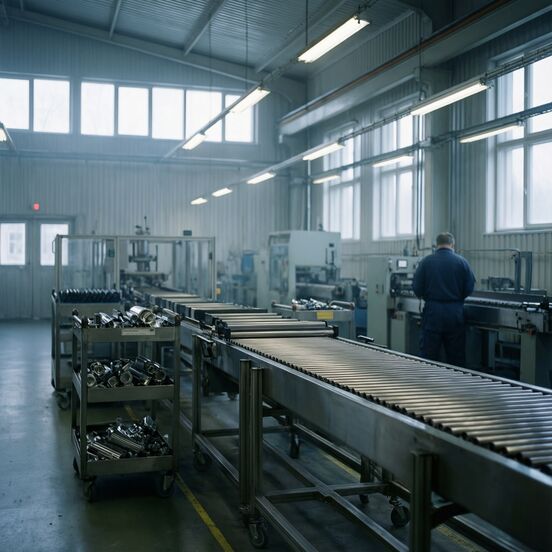
Epix-MPS is the production part of Epix and sits in the same system as orders, purchasing and the warehouse. That means a production order counts against the same stock balance as picking, and that material kitting to the production stations is handled as ordinary warehouse work.
Product structures can be broken down into any number of levels, and variants can be defined at each level of the structure. Gross and net requirement calculation starts from the current balance, reservations and the production plan, with lead times taken from OIS. Scrap is registered during manufacturing, so material losses can be analysed rather than turning up as discrepancies afterwards.
Once a product is finished it becomes a pallet in WMS with its own batch ID and enters the ordinary outbound flow.
Customer case


Property and service
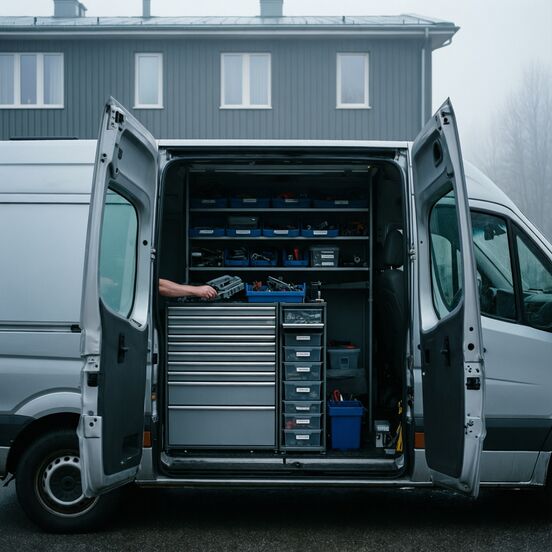
In property management and service work the challenge is that the stock is dispersed. Materials sit partly in the central store and partly in each service van, and it is the balance in the vans that decides whether a job can be completed on the first visit or needs a second.
In Epix a service van is handled as a storage location with a balance of its own. Consumption is reported on site from a handheld terminal, and the vans are replenished using the same replenishment logic as picking locations in the warehouse. Materials are therefore booked against the right job without anyone having to transfer figures afterwards.
Our customers here include municipal housing companies and utilities — ÖBO, Vivab, Hyresbostäder i Norrköping and Ulricehamns Energi.